
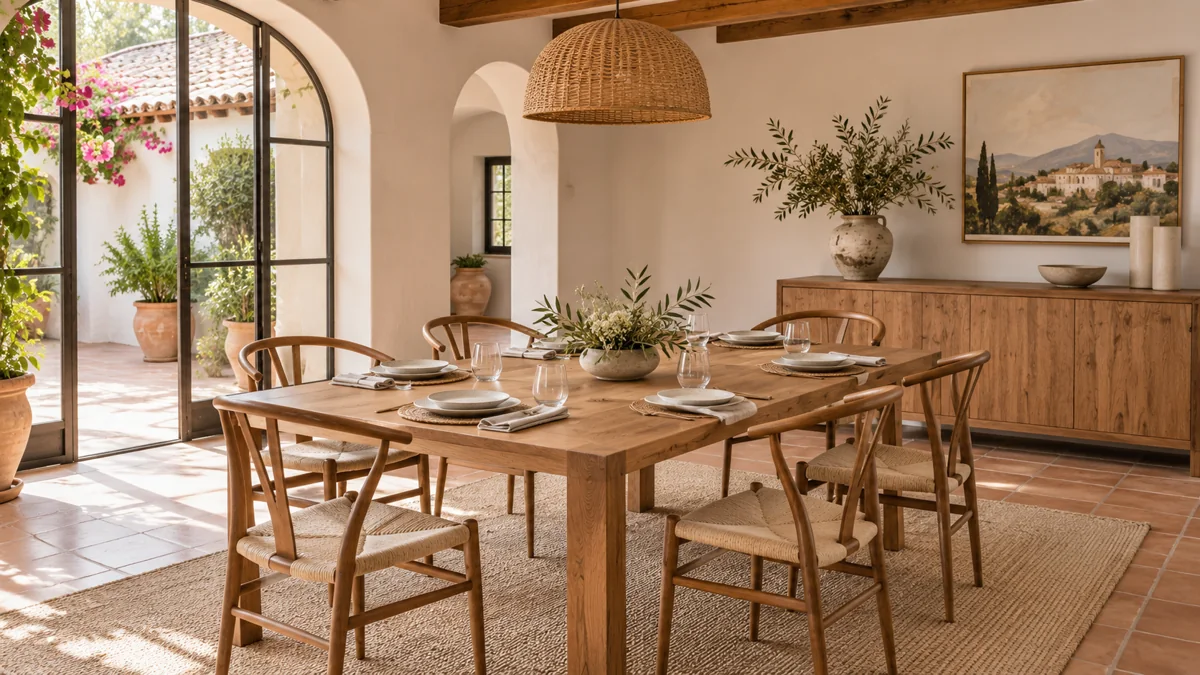
You carry a hot dish toward the table and discover that a chair or a tall centerpiece cuts the path. The serving route at the table is the real path that dishes, plates and people take when serving and clearing. Spotting it before seating anyone avoids bumps, unnecessary standing up and plates passed over other people’s hands.
The infographic that follows summarises at a glance the clear flow and the most common blockages in an illustrative example for six people. There are no universal measurements: every home has its real space. The goal is to see clearly where it is worth clearing or moving something before the gathering.
Visual map of the serving route and table obstacles
The following infographic shows a top-down view of a rectangular table as an illustrative example with six places. Soft arrows indicate the clear serving route (entry from the kitchen, access to the main dish and clearing toward a stable support out of the walkway). Coral-toned zones mark typical obstacles: a chair too close to the wall, a centerpiece that blocks sight and passage, or a tray invading the entry.
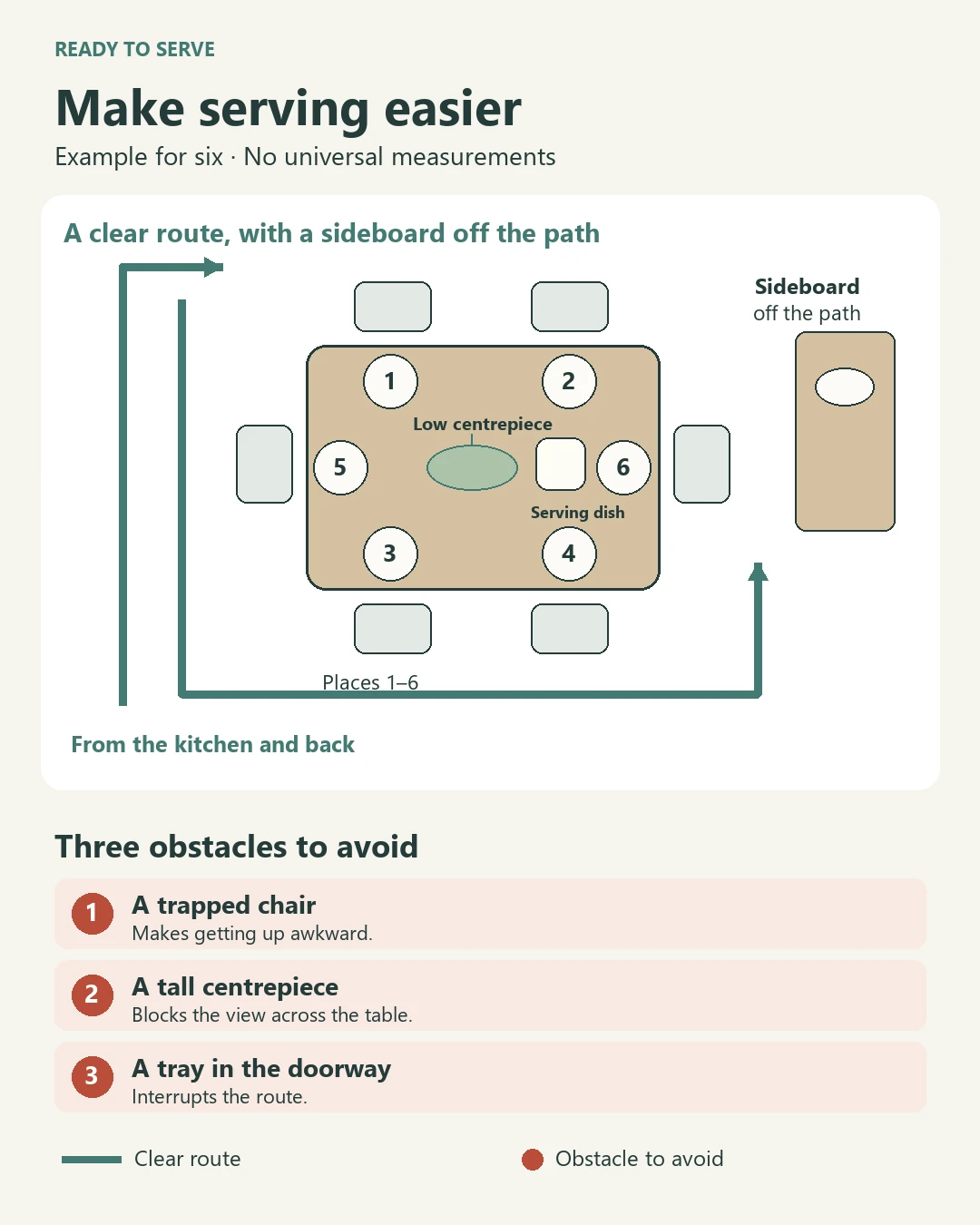
Read it from top to bottom or by zones: first the clear flow, then the friction points. It is an illustrative sketch, not a plan with fixed distances. Use it to compare with your own table and spot similar blockages.
Accessible transcription and step-by-step checks
The infographic represents an illustrative example of six diners. Visible elements:
- Rectangular table with six chairs and individual plates.
- Low, clear centerpiece in the middle that allows eye contact across the table.
- Main serving dish accessible on the table.
- Stable auxiliary support (sideboard or small table) out of the walkway, for clearing plates or holding the next dishes.
- Access direction from the kitchen marked with continuous clear-route arrows.
- Three obstacles highlighted: chair too close to wall or sideboard, tall centerpiece blocking view and passage, and element invading the entry from the kitchen.
Legend: soft colour (sage green or slate blue) = clear serving route. Coral accent colour = obstacle or friction point.
Short list of quick checks (try them in your home without universal rules):
- Can each person sit and stand without forcing someone else to move?
- Is there practicable space behind the chairs to serve or clear without bumps?
- Does the centerpiece allow you to see the person opposite and leave real room for dishes?
- Is there a stable support out of the walkway for used plates or the next dishes?
- Is the entry from the kitchen clear, or is a chair or tray blocking it?
If you need the full organisation procedure according to the real space of your table, see how to organise the Christmas table with real space.
What to adjust before the gathering
Clearing the serving route and having a stable support out of the walkway changes the dynamics of the meal. The need to ask someone to stand, to pass plates over other hands or to improvise unstable supports is reduced.
The most useful adjustment is often small: remove or lower a centerpiece that blocks, shift a chair that cuts the path, or prepare a nearby sideboard for the next dishes. With those changes service flows and the table feels more comfortable for everyone.
If you are preparing the rest of the season, the guide to preparing Christmas in advance provides the overall framework.
Frequently asked questions about the serving route
What if not all dishes fit on the table at once?
Use the auxiliary support out of the walkway. Leave only the main accessible dish on the table and keep the next ones ready on the sideboard or side table. This keeps the route clear.
How do I know if a centerpiece is in the way without fixed measurements?
Sit at one end and look toward the other. If you cannot comfortably see the person opposite or there is no real room to set a dish down, the centerpiece is interfering. Lower it, reduce it or move it.
Where do I place the auxiliary support if the kitchen is far away?
Choose the nearest stable point to the table that does not invade the path behind the chairs. It can be a sideboard, a small auxiliary table or even the end of a console. What matters is that it does not force anyone to cross the main circulation zone.
Does the infographic map work for round tables or other sizes?
The sketch is an illustrative rectangular example for six people. The principle applies the same way: identify the clear route, the friction points and a support out of the walkway. Adapt the idea to the real shape of your table.
Discover more from Unique trends in fashion, home décor, lifestyle, and gifts
Subscribe to get the latest posts sent to your email.