
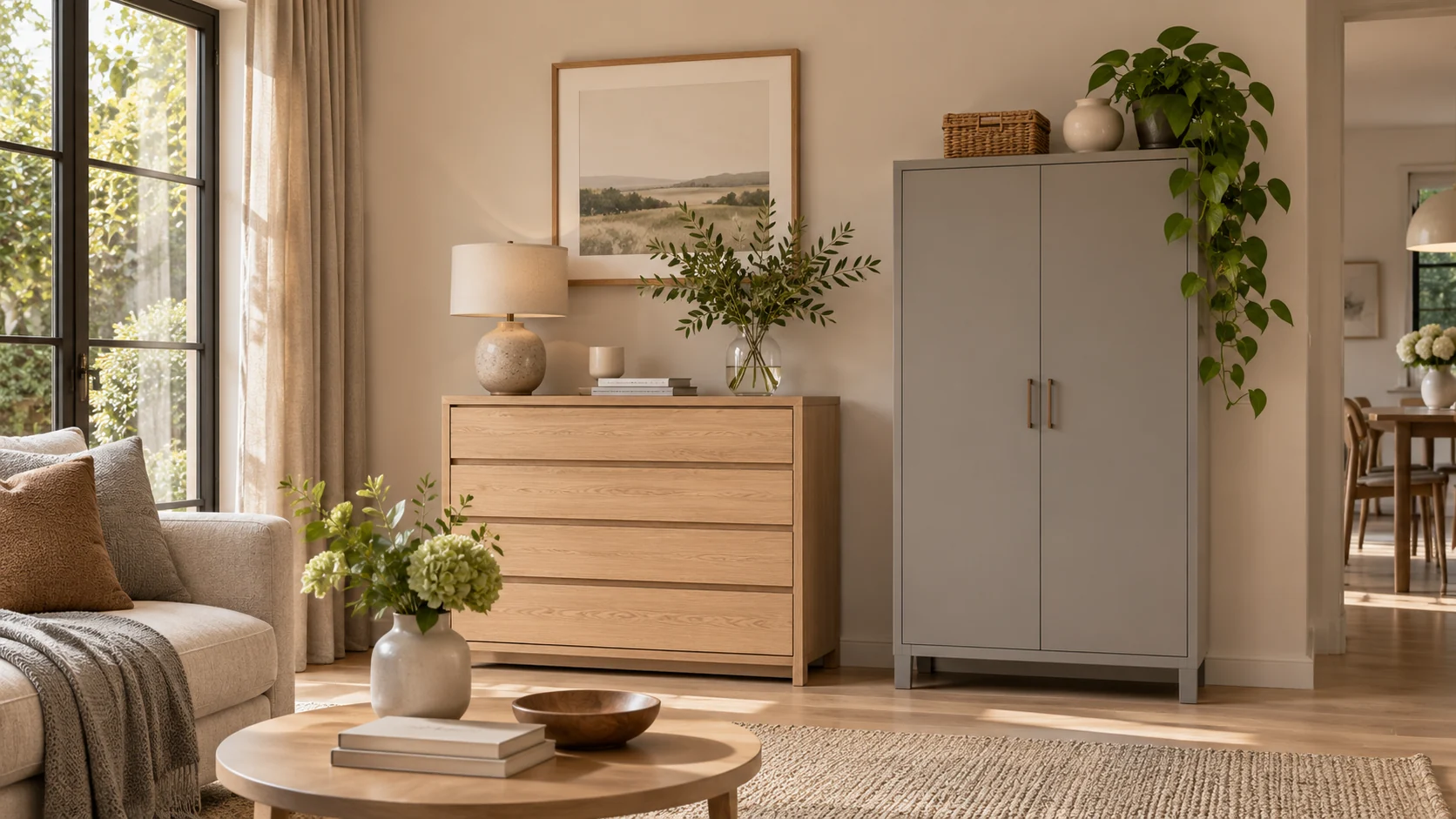
When you are deciding between drawers or doors and shelves, the answer is not in the furniture but in what you are going to store. A drawer shows you the contents from above; a door with shelves makes use of the interior height. The difference shows every time you open the piece to take something out. In this comparison we review both systems with two documented models as examples and criteria you can check before deciding.
Two documented models for comparison
To make the comparison concrete, we use two auxiliary pieces that represent each system. They are not interchangeable: their opening systems, dimensions and uses are different.
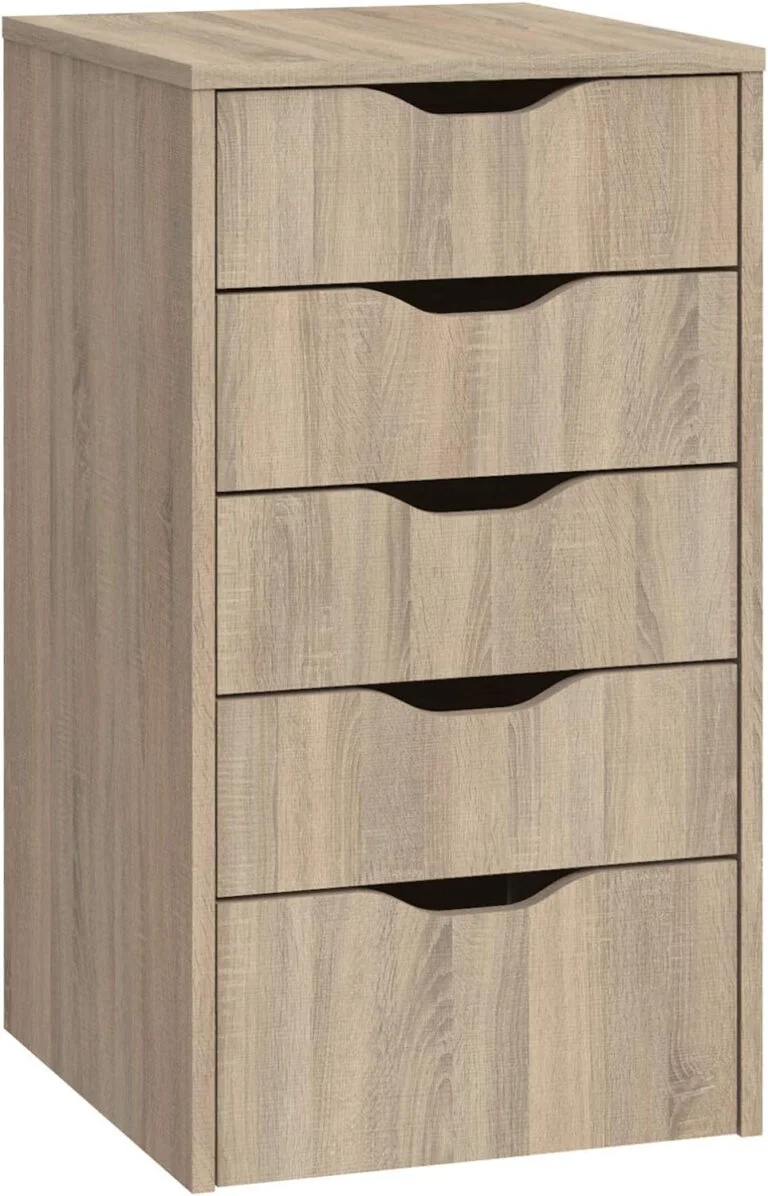
Pitarch: five front-extraction drawers
The Pitarch chest of drawers is made from particle board and melamine. It has five drawers with metal runners and requires kit assembly. Its exterior dimensions are 71 cm high, 40 cm wide and 43 cm deep. The declared internal usable dimensions are 10 cm high, 31 cm wide and 33 cm deep for the four upper drawers, and 14 cm high for the lower drawer .
It is worth checking the actual free height when closing, down to the lowest obstacle. No maximum load is accredited, nor can it be assumed that archive boxes or shoes fit without measuring.
Last update 11/25/2026
As Amazon Associates, we earn from qualifying purchases.
Final price and availability are confirmed on Amazon at the time of purchase.
More details in our affiliate disclosure.
SoBuy FRG238-DG: one drawer and two doors with a shelf
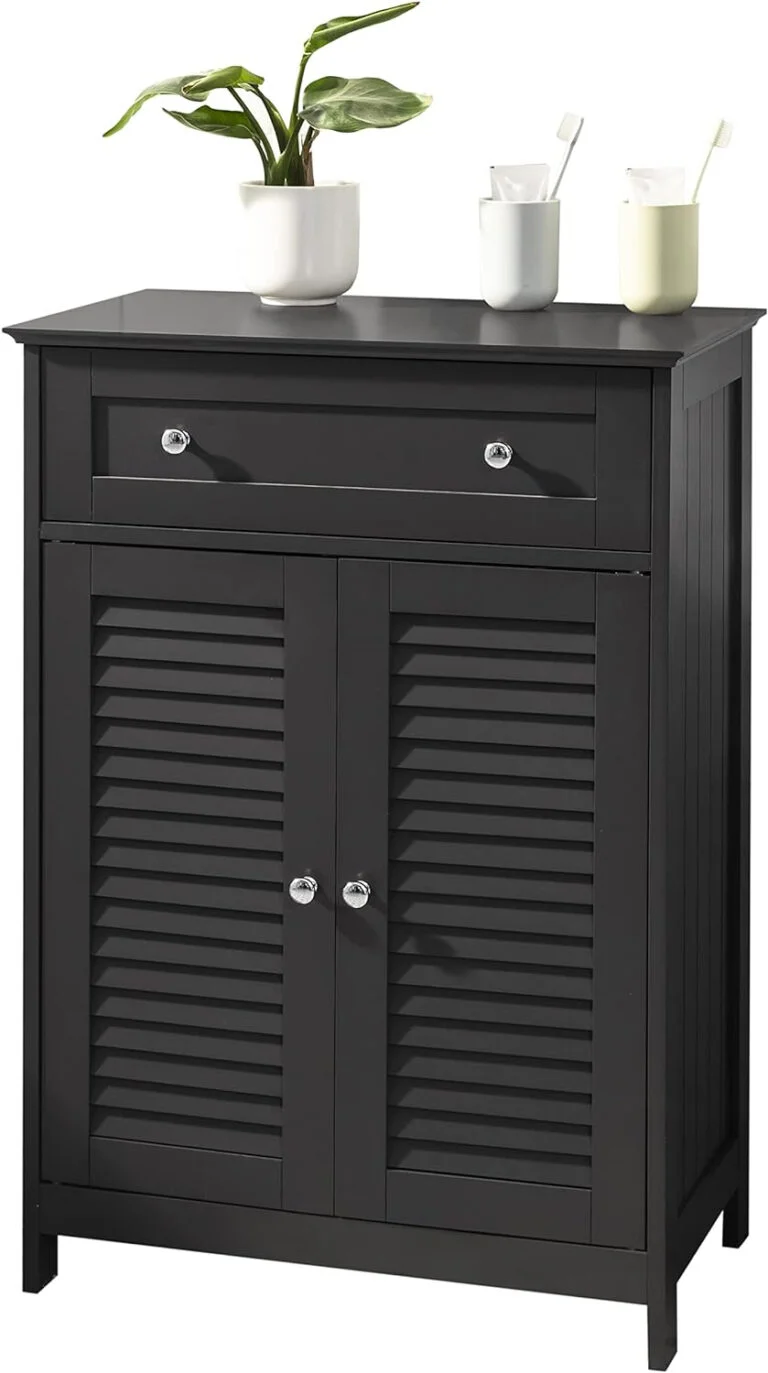
The SoBuy FRG238-DG auxiliary cabinet combines a top drawer with two lower doors and an internal shelf. It is made from MDF and particle board, and requires assembly. Dimensions and load figures show contradictions between sources, so they are omitted from this comparison .
It should not be assumed that there is a specific free height for tall containers without confirming it, nor should it be treated as interchangeable with the chest of drawers. It should also not be confused with the FRG236-DG or FRG237-DG models.
Technical features of each system
The two systems follow different logics. A drawer pulls the contents outwards; a door with shelves requires access from the front.
- Pitarch: five drawers, metal runners, particle board/melamine, kit assembly. Internal dimensions declared by the manufacturer .
- SoBuy FRG238-DG: one top drawer, two lower doors, one internal shelf, MDF/particle board, assembly required. Dimensions and loads omitted due to contradictions between sources.
Materials, design, functions and suitability for use
The melamine-faced particle board of the chest and the MDF with particle board of the auxiliary cabinet serve different purposes. Melamine offers an easy-to-clean surface; MDF allows varied shapes and finishes. Neither data point alone defines the quality of the furniture.
The practical difference is access. A front-extraction drawer lets you see the contents from above and take what is at the back without emptying half the piece. A door with shelves makes better use of interior height, but requires front space to open the door and often requires bending down to reach the back.
A drawer needs a horizontal opening path; a door needs a swing. Both need free space in front. Before choosing, measure the passage strip and check that the opening does not hit other furniture or walls.
Relevant alternatives compared by features
The choice depends on the object. This table summarises which system tends to fit each type of content, without rankings or prices.
| Object type | System that tends to fit | Check before buying | Limit to keep in mind |
|---|---|---|---|
| Small, flat everyday objects (stationery, cables, cutlery) | Front-extraction drawer | Internal free height and opening path | If the object exceeds the free height, the drawer will not close |
| Wide or tall items for occasional use (towels, large containers, boxes) | Doors with shelves | Height between shelves and front opening space | If the shelf is not adjustable, the height is fixed |
| Everyday objects with quick access | Top drawer or chest of drawers | That the drawer extends fully or sufficiently | A partial-extraction drawer leaves part of the back hidden |
| Secondary or seasonal storage | Doors with deep shelves | That the door opens without blocking the passage | Contents at the back may be less accessible |
Pros and limits of each system
Drawers. Advantage: visual and quick access, especially for small, flat objects. Limit: internal free height and opening path condition what fits and how it is used.
Doors with shelves. Advantage: they make use of vertical height for large items or boxes. Limit: they require front space to open, and access to the back takes more effort. The height between shelves may not be adjustable if the manufacturer does not confirm it.
Specific benefits and contexts of use
In a work corner, a chest like the Pitarch can organise stationery and small cables if the internal dimensions match what you store. In a bathroom or auxiliary area, a piece like the SoBuy FRG238-DG can organise towels and toiletries behind closed doors, if the front space allows the doors to open comfortably.
It is not about choosing one system for the whole house. It is about assigning each system to the type of object and the available space. A home can combine drawers for small items and shelves for bulky ones.
Evidence, verifiable reviews and their limits
This comparison is based on data declared by the manufacturer or seller. It does not include verified reviews or our own tests. Before deciding, therefore, it is worth checking the actual free height when closing, the drawer extraction path and the distance between shelves if the piece has them.
If the listing does not state an internal measurement, ask the seller. If they do not provide it, that absence is relevant to the decision. Do not assume an object fits just because the furniture looks roomy in the photo.
Frequently asked questions
What is the difference between exterior and internal usable measurements?
The exterior measurement is the size of the furniture. The internal usable measurement is the actual space available inside the drawer or between shelves. A piece can measure 43 cm deep on the outside and offer 33 cm of usable depth inside, as happens in the upper drawers of the Pitarch .
What if the listing does not state the drawer free height or the gap between shelves?
Without that data you cannot confirm that your objects fit. Ask the seller before buying. If they do not provide it, apply caution: wait or look for a model with declared internal measurements.
Does a closed door protect against direct humidity?
A closed door can reduce direct exposure, but it does not guarantee protection against ambient humidity. If the piece goes in a bathroom, check the manufacturer’s indications on the material and maintenance.
How do I decide if I already have drawers without dividers?
Before buying new furniture, try organising the existing drawer with trays or dividers. If the drawer has the depth and height you need, an internal organiser can solve the problem without changing the piece.
Conclusion and next step
The choice between drawers and doors with shelves depends on what you store and the space you have. Drawers win on visual access and speed for small objects. Doors with shelves win on vertical use for bulky items. Many homes work better by combining both.
If you want to go deeper into choosing storage based on your routine, the storage selection guide helps you decide by object type and frequency of use. If you need to measure the space and check the opening before buying, the measurement tutorial has the step-by-step.
Discover more from Unique trends in fashion, home décor, lifestyle, and gifts
Subscribe to get the latest posts sent to your email.