
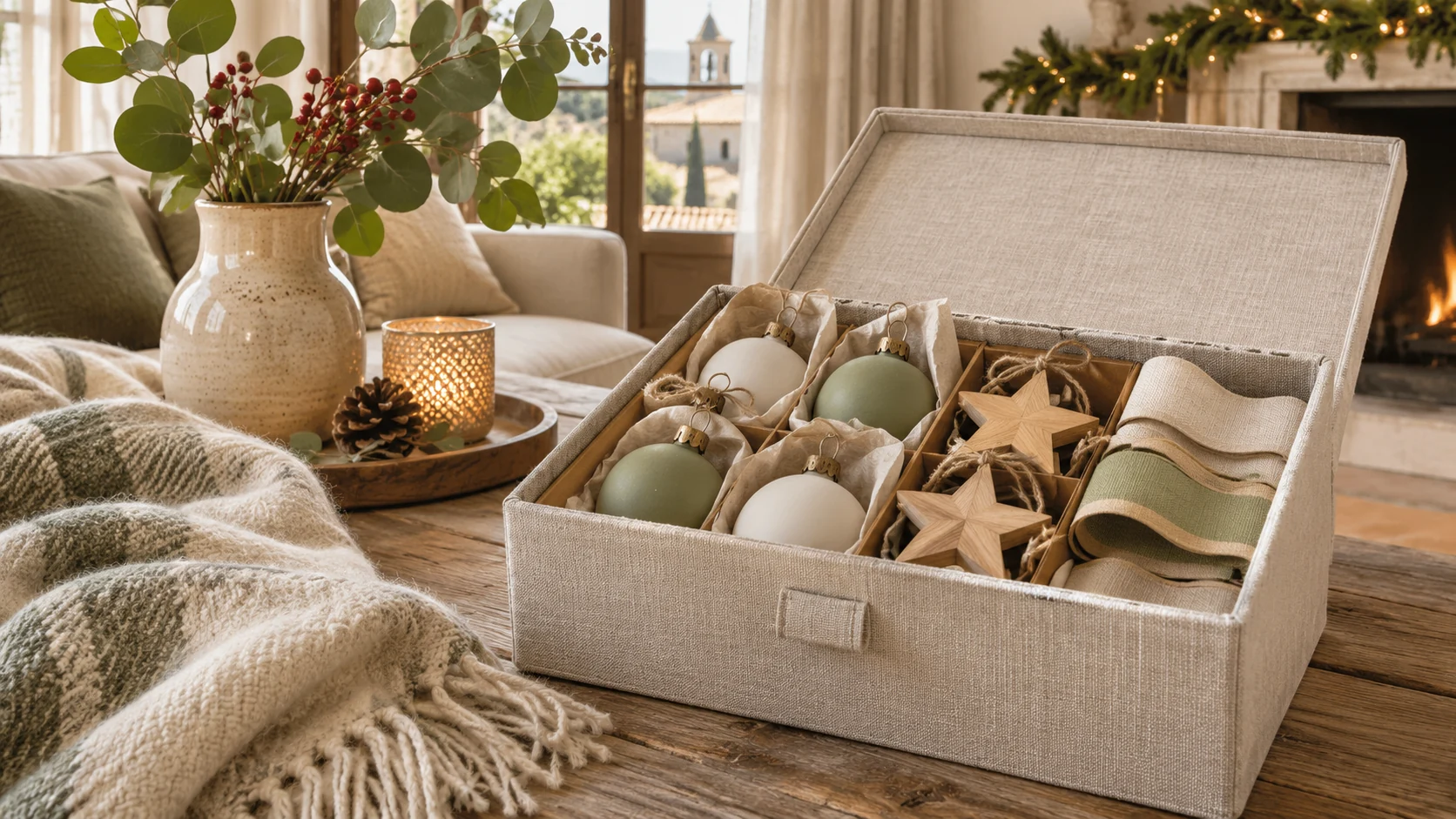
You take the ornament boxes out of the cupboard and wonder what deserves to return to the living room this year. What are reusable Christmas decorations: they are the pieces we keep in good condition and can use again in other celebrations, from baubles and figures to festive textiles and lights that remain safe. Understanding this concept helps you decide with clarity before decorating or buying.
It is not about never buying. It is about knowing what can be kept, what needs checking and what is no longer advisable to use. This way the decoration lasts more seasons and stays coherent with what you already have at home.
Real scope: what belongs and what does not in reusable decoration
Reusable Christmas decoration includes hanging ornaments, stable centrepieces, seasonal textiles and lighting elements that remain intact and safe for their intended use. Single-use consumables, damaged pieces and protected natural elements that must not be freely collected fall outside the concept.
Reusing is a criterion of conservation and compatibility. It is not a magic label or a dogma. It means the piece is still useful and safe according to its manufacturer’s instructions and the way you use it at home.
Varied examples of materials and reusable pieces
Glass and ceramics
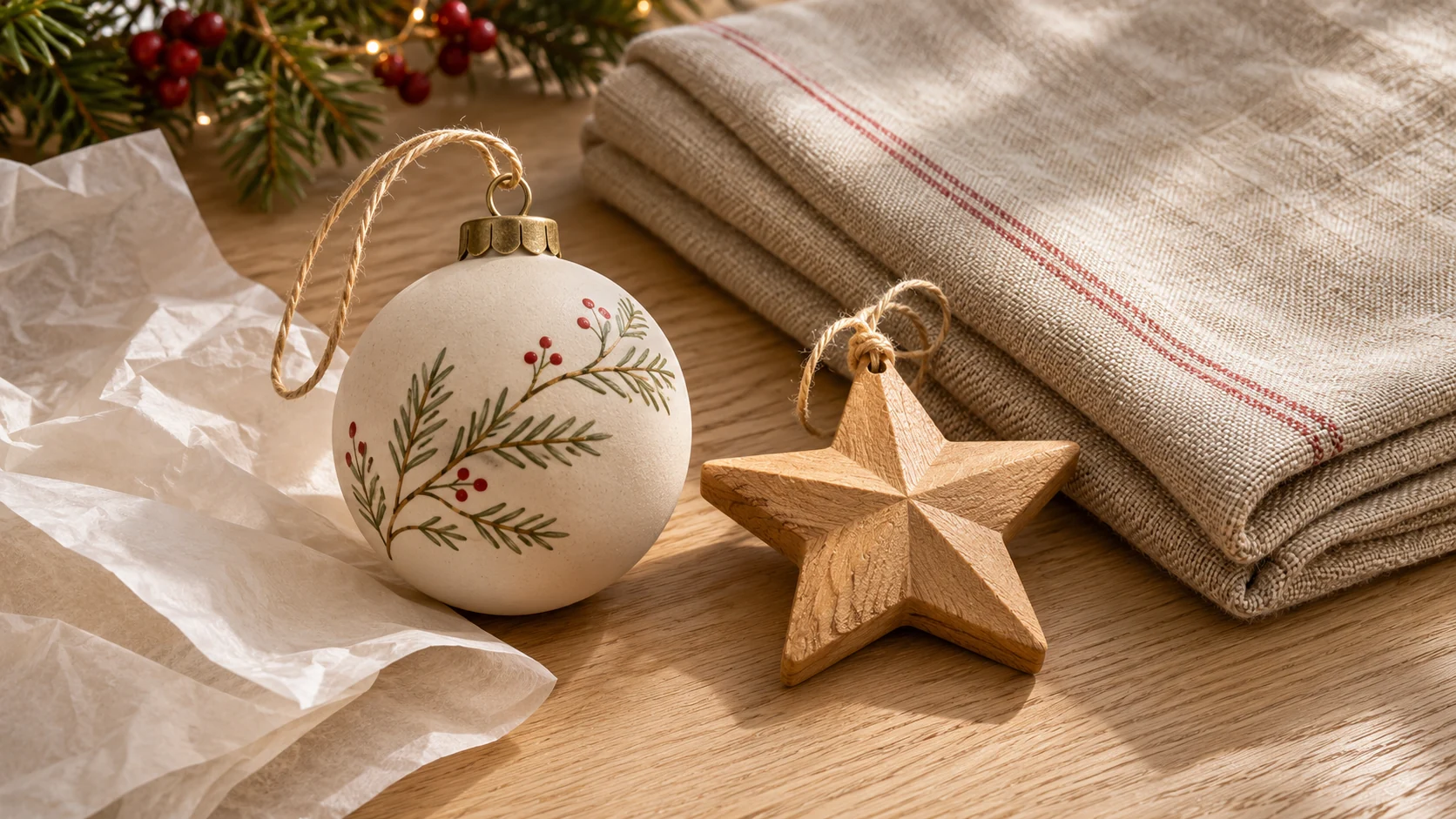
Baubles, figures and glass or ceramic centrepieces that are well protected can last many seasons if they are stored without crushing and cleaned carefully. Their durability depends on thickness and how they have been treated.
Wood and treated natural fibres
Stars, silhouettes or wooden and treated-fibre ornaments reuse well when they show no splinters or deformation. Follow the manufacturer’s guidance on humidity and cleaning.
Metal and washable textiles
Light metal ornaments and table runners, cushions or fabric ribbons usually stay in good condition if they are thoroughly dried before storage. Avoid residual moisture that causes odours or stains.
Reviewed garlands and lights
Garlands are only considered reusable when cables, connections and lights are in good condition. A burnt-out bulb or damaged cable changes the assessment of the whole piece.
Reusable, worn out or necessary complement: how to tell them apart
Before deciding what returns to the living room, it helps to classify each piece according to its real condition. This table summarises the criteria in a practical way.
| Observed state | What it means | Decision criterion | What to check |
|---|---|---|---|
| Reusable as is | Clean, intact and safe piece for its intended use | Can be put back | No breaks, sound cables, clear instructions |
| Pending review | No visible damage, but use or compatibility still needs confirming | Check before deciding | Manufacturer instructions, indoor/outdoor use, connection condition |
| Worn out | Breaks, cut cables, burnt-out lights or pieces that fall apart | Do not reuse | Do not improvise electrical repairs; remove safely |
| Necessary complement | Real gap detected after reviewing what is available | Add with intention | Fits with what you already keep and covers a concrete need |
This classification avoids both discarding useful pieces and forcing the use of elements that are no longer safe.
Safety limits and what should not be reused
Not everything that lights up or looks whole is reusable. Frayed cables, burnt-out bulbs, splintered pieces or proximity to heat sources are clear limits. Indoor versus outdoor use also matters: a piece intended only for indoor use should not be placed outside.
CE marking is a declaration of conformity by the responsible party with the applicable requirements. It is not an independent certification and does not by itself guarantee the total absence of risks. Do not attribute properties the product does not declare and avoid homemade electrical repairs. For more detail on the meaning of the marking you can consult what CE marking on string lights means.
The limit of natural elements and vegetation
Branches, moss or wild fruits are not freely collectable reusable decoration. In the Community of Madrid, the 2024 campaign recalls that species such as holly, yew and cork oak are protected and warns against pulling moss, branches or bark. The fact that an element is on the ground does not authorise collecting it. That list is territorial and must not be extrapolated as a general permit across Spain.
It is also not advisable to return ornaments to the natural environment. Prioritise reusable pieces already acquired or elements of accredited origin, and check local rules when in doubt.
What good conservation involves: cleaning, protection and environment
A reusable piece lasts several seasons when its care is respected. Following the manufacturer’s instructions, thoroughly drying textiles before storage, protecting fragile items without crushing them and avoiding excessive moisture or heat when storing are the factors that most influence durability.
The aim is not a rigid protocol but to understand why pieces deteriorate: moisture causes odours and mould, crushing breaks glass and heat deforms plastics or fades fabrics.
When to add a necessary complement without losing coherence
Adding or renewing specific pieces is valid when it covers a real gap, adds warmth or replaces something worn out. Buying with criteria to enjoy the home is not at odds with keeping what already works.
The key is that the complement responds to a need or a conscious preference and fits with what you already keep. This way the decoration gains coherence instead of accumulating loose pieces.
How to combine what you already have with new or borrowed pieces
Preserved ornaments gain new life by changing location, grouping them by colour or texture, or integrating a punctual complement. A set of baubles in the same tone in a different corner, a fabric ribbon reused on another piece of furniture or a inherited figure next to a new piece can refresh the atmosphere without starting from scratch.
A total transformation is not required. Small visual adjustments are often enough for the reusable pieces to feel current.
Relation to your Christmas preparation and next decisions
Understanding what reusable Christmas decorations are connects with other household decisions: reviewing stocks before buying, choosing lighting according to real use and thinking about reusable wrapping. If you are organising the season in advance, the guide to preparing Christmas in advance provides the overall framework. For lighting, the guide to decorative Christmas lighting by use helps decide location and power type.
Conclusions: enjoying decoration that lasts more than one Christmas
Reusable Christmas decoration is based on keeping safely, distinguishing wear and choosing complements with intention. It does not require giving up taste or turning the home into a storeroom. It requires looking at what you already have, caring for what works and adding only what contributes.
With those criteria, decoration gains coherence and useful pieces accompany more than one season.
Frequently asked questions about reusable Christmas decorations
Is a garland with one burnt-out light still reusable?
Not automatically. If there are burnt-out lights or damaged cables, the whole piece needs review. Do not improvise electrical repairs; assess whether the set remains safe according to its real condition.
Does hard plastic always last the same?
No. Plastic discolours, cracks or deforms with heat, sunlight or crushing. Check the real condition of the piece each season.
What should I look at in inherited ornaments without a label?
Check integrity, absence of splinters or sharp edges, condition of any cable or connection and whether the use you want to give it is coherent with its appearance and material. When in doubt, prioritise safety.
Does decorating with taste require spending a lot or buying nothing?
Neither extreme. Keeping what is reusable and adding only the complements that cover a real gap allows you to enjoy the home with coherence, without unnecessary accumulation or forced renunciation.
Can I use vegetation from the garden or the woods?
It depends on the species and local rules. Do not collect protected species or pull moss, branches or bark. Check the guidance of your region and prioritise elements of accredited origin.
Does CE marking guarantee a piece is safe forever?
No. CE marking is a declaration of conformity at the moment the product is placed on the market. It does not replace checking the current condition of the piece or following the instructions for use and conservation.
Discover more from Unique trends in fashion, home décor, lifestyle, and gifts
Subscribe to get the latest posts sent to your email.