
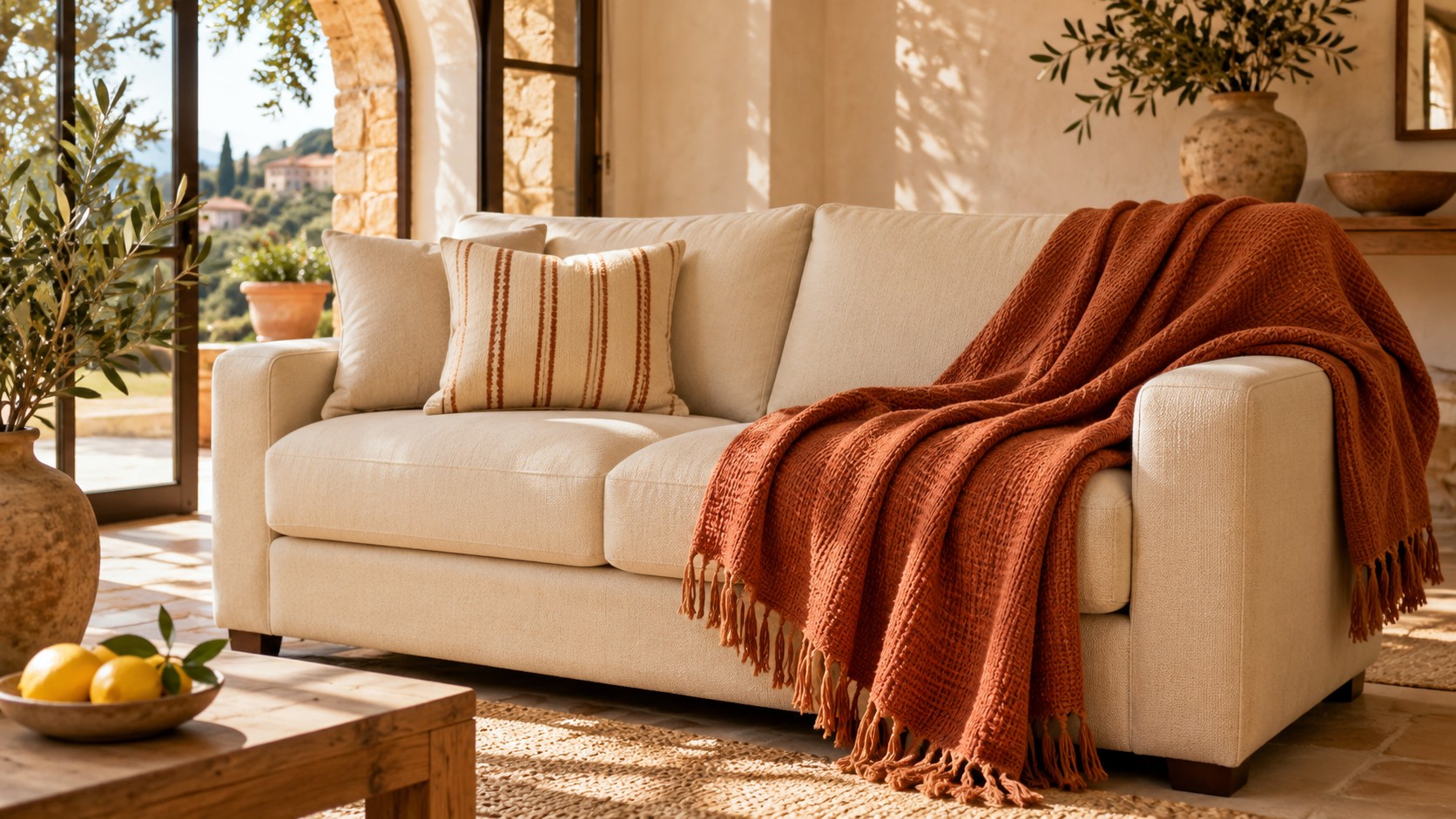
A sofa throw can make a living room feel more inviting. Size, fabric, and how easy it is to care for determine whether you actually use it every day or fold it away.
This guide helps you choose with practical criteria. We show how to measure according to the use you will give it, how to distinguish fiber, construction, and finish, and why you should always check the care label of each individual piece. There are no universal sizes by number of seats and no fixed temperatures.
Table of contents
- Size According to Use
- Fabric and Composition
- Care According to the Label
- Conclusion
- Frequently Asked Questions
Size According to Use
Size is not decided by how many seats the sofa has. It is decided by how you plan to use the throw.
For personal use it helps to work with two independent measurements:
- Length: from the highest point you want covered (shoulder, chest, or waist) down to where you want the throw to end (knees, ankles, or beyond).
- Width: the width that feels comfortable for covering or wrapping without feeling too narrow or excessive.
Take a measuring tape, sit or recline in your usual position, and note those two figures separately. This lets you compare clearly with the dimensions of the throw.
For decorative use the test is a placement check. Fold or drape the throw over the arm, back, or seat exactly as you imagine it will look. See whether the proportions please you, whether there is too much fabric, or whether it looks too short. This test tells you more than any seat-count chart.
A throw that is longer than needed may create more folds than you want; one that is too short may leave areas uncovered depending on how you sit. What matters is that the size matches how you use it and the effect you are looking for.
Fabric and Composition
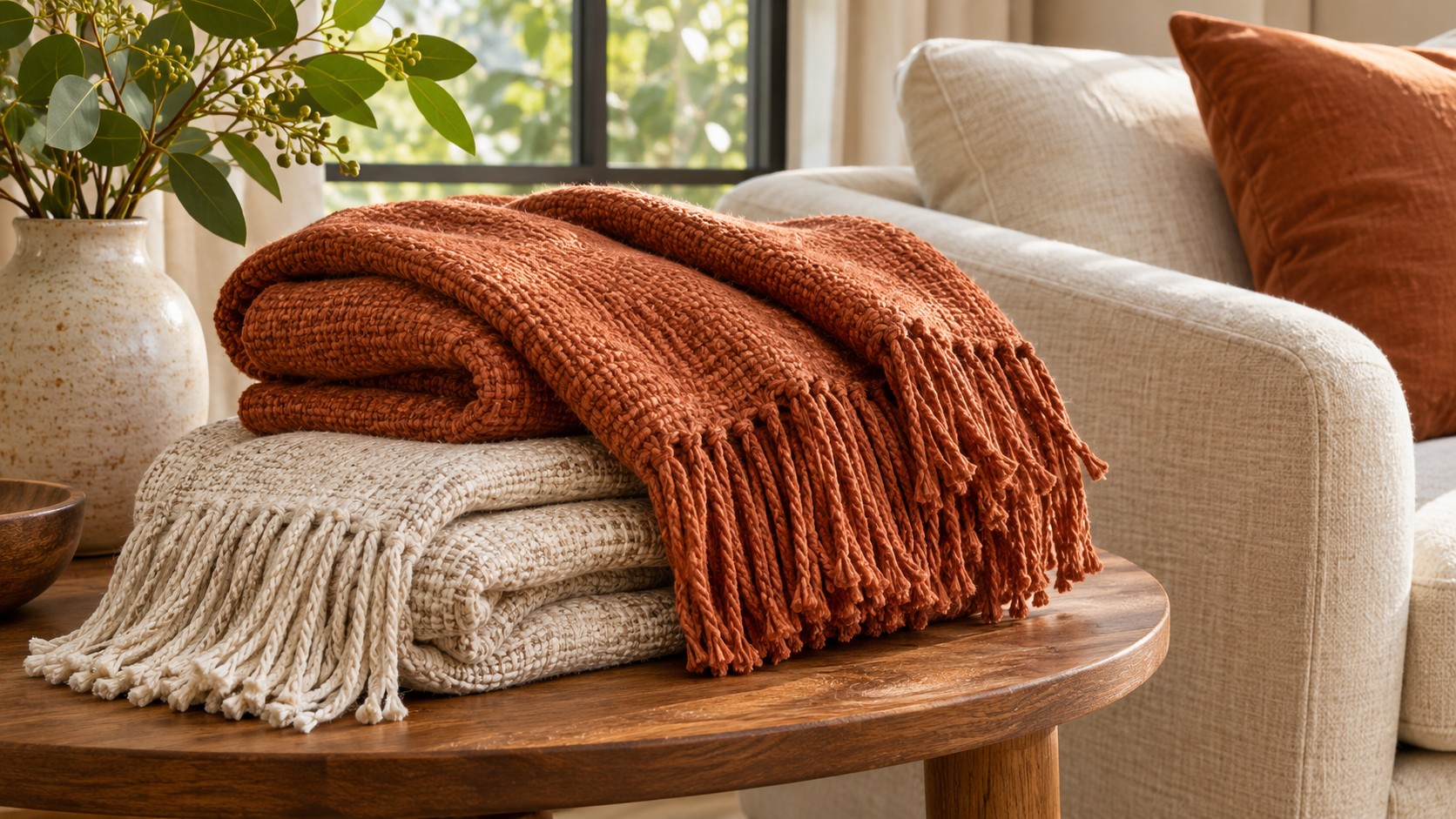
It helps to keep three concepts separate:
- Fiber: the raw material (cotton, wool, polyester, acrylic, etc.).
- Fabric or construction: how those fibers are organized (knit, woven, chenille, etc.).
- Finish: surface treatments that affect hand-feel, sheen, or durability.
Chenille describes a type of yarn or construction with a soft, velvety look; it does not by itself tell you the fiber content. Microfiber refers to very fine fiber diameter, not to a specific composition (though many microfiber textiles are polyester).
In the European Union, fiber composition must appear on the label. You should find the name of each fiber and its percentage by weight, listed in descending order. Official information on textile labelling is available on the European Commission’s page: https://europa.eu/youreurope/business/product-rules-compliance/textiles-and-footwear/textile-label/index_en.htm
When choosing:
- Always check the composition on the label of the specific piece.
- Feel the hand and weight: a dense fabric feels different from a lightweight one even if the fiber is the same.
- Think about daily use: if the throw will frequently touch clothing or skin, hand-feel matters as much as composition.
There is no universally “best” fiber. There is the one that suits how you will use the throw and what feels pleasant to you.
Care According to the Label
Check the care label on the throw and the manufacturer’s instructions. That is the reference you should follow for washing and drying that specific piece.
The care symbols used on European textile labels follow the system developed by GINETEX. They indicate the maximum treatment the article can withstand. Lower temperatures or gentler cycles are usually allowed unless the label states otherwise. You can consult the meaning of the symbols on the GINETEX care-labelling page: https://www.ginetex.net/en/care-labelling/
Practical recommendations:
- Read the full label before the first wash.
- Do not assume temperatures or programs based on fiber type alone: two cotton throws can carry different instructions depending on finish or construction.
- If the label calls for hand washing or a delicate cycle, follow it.
- For drying, follow the corresponding symbol (line dry, dry flat, tumble dry, or do not tumble dry).
How the throw behaves (pilling, possible size changes, durability) depends on the specific piece, how you use it, and how closely you follow the label. Following the manufacturer’s instructions is the simplest way to care for it well.
Conclusion
Choosing a sofa throw comes down to three clear steps:
- Decide whether the main use is personal or decorative and measure or test accordingly (length and width separately for personal use; placement test for decorative use).
- Read the fiber composition on the label and consider hand-feel and weight.
- Always check the care label of that specific piece and the manufacturer’s instructions before washing or drying.
With those three points you have a solid basis for choosing a throw you will actually use and enjoy. Once you know the size that fits and have checked the label, you are ready to decide.
Frequently Asked Questions
Can I rely only on the number of seats on the sofa? No. Seat count does not define the coverage or drape you need. Measure according to your real use or do the placement test.
Do “chenille” or “microfiber” tell me what the throw is made of? No. They describe construction or fiber fineness. The actual composition appears on the label with the percentages of each fiber.
Are there universal washing temperatures? No. Each label states the maximum treatment allowed for that piece. Always follow the specific label and the manufacturer’s instructions.
Where can I look up the meaning of care symbols? On the GINETEX care-labelling page: https://www.ginetex.net/en/care-labelling/
What about fiber composition? Official information on textile labelling is available on the European Commission’s page: https://europa.eu/youreurope/business/product-rules-compliance/textiles-and-footwear/textile-label/index_en.htm
Discover more from Unique trends in fashion, home décor, lifestyle, and gifts
Subscribe to get the latest posts sent to your email.